History
The story of a land where East and West met along the oases of the Silk Road.
Highlights.
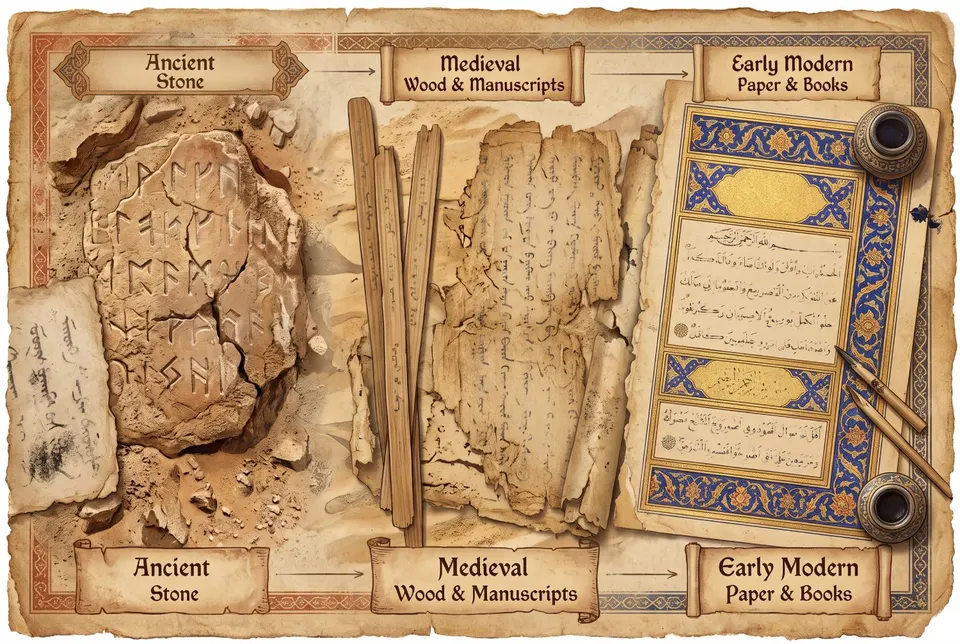
Uyghur history through its scripts
The languages of the Uyghurs have been written in different scripts over time: the Old Uyghur script, derived from Sogdian; the Arabic script that came with Islam; and the present alphabet reformed in the 20th century.
History / تارىخ
Read the article →01From a nomadic state to kingdoms
In the mid-8th century the Uyghur Khaganate, a nomadic state, arose on the Mongolian Plateau. After it collapsed in 840, some of its people moved south and founded kingdoms near today’s Turpan and in Gansu.
02The oases and Islam
In the oases of the Tarim Basin, Islam spread gradually from the 10th century, and by the 16th century most of the people were Muslim. Under the Kara-Khanids and the Yarkent Khanate, Kashgar and Yarkent served as capitals.
03Old and present-day Uyghurs
Sources describe the link between the old Uyghurs and the Uyghurs of today in different ways. One account describes modern Uyghurs as descended from several peoples, including the Uyghurs who came from the Mongolian Plateau and those who lived in the Tarim Basin before them.
Timeline
The history of the dynasties and how the scripts they used changed (8th century to today)
States and dynasties
Events and writings
Scripts in use
Hatched: only the century is known, or sources give different years
Uyghur Khaganate
- Period
- 744–840
- Capital / base
- Ordu-Baliq (Mongolian Plateau)
- Script
- Old Turkic script (inscriptions)
A nomadic state centred on the Mongolian Plateau that flourished for about 100 years. In the later 8th century the khagan took up Manichaeism, which later became the state religion. In 840 a Kyrgyz invasion took the capital and the state fell; its people then moved to the oasis lands to the west.
Sources (22)
- [1]Wikipedia(英語版)「Uyghur Khaganate」
- [2]Wikipedia(日本語版)「回鶻」
- [3]Wikipedia(英語版)「Old Uyghur script」
- [4]Wikipedia(英語版)「Qocho」
- [5]Wikipedia(日本語版)「天山ウイグル王国」
- [6]Wikipedia(日本語版)「甘州ウイグル王国」
- [7]Wikipedia(英語版)「Ganzhou Uyghur Kingdom」
- [8]Wikipedia(英語版)「Kara-Khanid Khanate」
- [9]Wikipedia(日本語版)「カラハン朝」
- [10]Wikipedia(英語版)「Uyghur alphabets」
- [11]Wikipedia(英語版)「Uyghurs」
- [12]Wikipedia(日本語版)「ヤルカンド・ハン国」
- [13]Wikipedia(英語版)「Yarkent Khanate」
- [14]Wikipedia(英語版)「Amannisa Khan」
- [15]Wikipedia(日本語)「クタドゥグ・ビリグ」
- [16]Wikipedia (en)「Kutadgu Bilig」
- [17]Britannica「Kutudgu bilig」
- [18]Wikipedia(日本語)「マフムード・カーシュガリー」
- [19]Wikipedia (en)「Dīwān Lughāt al-Turk」
- [20]Wikipedia(英語版)「Dzungar conquest of Altishahr」
- [21]Wikipedia(英語版)「Revolt of the Altishahr Khojas」
- [22]Wikipedia(英語版)「Uyghur Arabic alphabet」
How the script changed
- 1
Old Uyghur script
8th–17th centuryOld Uyghur script. Derived from cursive Sogdian, it was used to write Old Uyghur and became the model for the later Mongolian script. The Arabic script of modern Uyghur is not derived from it. Inscriptions also used the Old Turkic (Orkhon) script. - 2
Arabic script
10th–early 20th centuryChagatai Arabic script. It arrived with Islam in the 10th century and was later used for Chagatai, the region’s literary language. It did not mark the vowels clearly, and it was used almost alone until the early 1920s. - 3
Uyghur script today
20th century–ئۇيغۇر يېزىقىuyghur yéziqiModern Uyghur script. It has 32 letters based on Arabic, and a 20th-century reform made every vowel written. Uyghur is also written in Latin letters (ULY) and, in former Soviet countries, in Cyrillic.
Sources (9)
- [1]Wikipedia(英語版)「Old Uyghur script」
- [2]Wikipedia(日本語版)「古ウイグル文字」
- [3]Wikipedia(英語版)「Old Turkic script」
- [4]Wikipedia(日本語版)「突厥文字」
- [5]Wikipedia(英語版)「Uyghur Arabic alphabet」
- [6]Wikipedia(英語版)「Uyghur alphabets」
- [7]Wikipedia(英語版)「Chagatai language」
- [8]Wikipedia(日本語版)「ウイグル語」
- [9]ئۇيغۇر تىلىنىڭ ئىزاھلىق لۇغىتى(ug.wikipedia 転載)見出し語「يېزىق」
Words of this field
- قەشقەرqeshqerKashgar
- ھۈنەرhünertechnique; skill; art; craft
- تارىخtarixhistory
- ئەسىرesircentury
- خانلىقxanliqkhanate
- خاقانxaqankhagan
- ئىدىقۇتidiqutidiqut
- مانىmaniManichaeism; a Manichaean
- قاراخانىيلارqaraxaniylarKara-Khanid Khanate
- يەكەنyekenYarkant
- تۇرپانturpanTurpan
- خوتەنxotenHotan
- ئۇيغۇر يېزىقىuyghur yéziqiUyghur script