1Old Uyghur script, from Sogdian
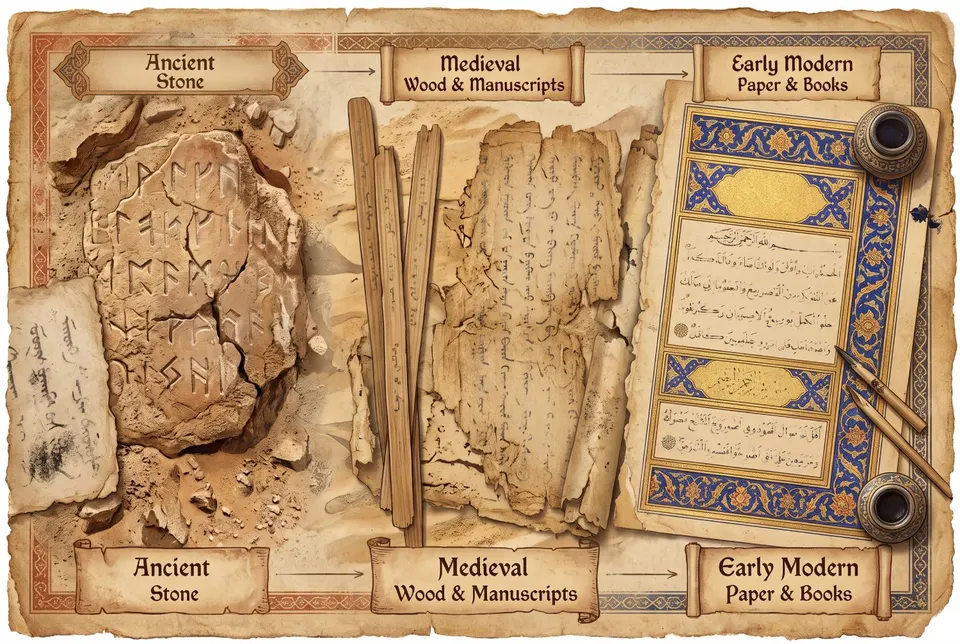
The Old Uyghur script grew out of the cursive script of the Sogdians, who were active along the Eurasian trade routes. Sources date its first use either to around the 8th century or to after 840. It was first written both across and down the page, and over time vertical writing became the norm.
The script became the model for the later Mongolian and Manchu scripts. In the Mongol Empire the script used for Mongolian was still called “the Uyghur script”.
2The Kara-Khanids and the Arabic script
The Kara-Khanids, a Turkic dynasty with قەشقەر among its capitals, adopted Islam in the 10th century. The first Arabic-based alphabet for Uyghur was also made in the 10th century, when Islam arrived.
Mahmud al-Kashgari, a Kara-Khanid scholar, wrote the first comprehensive dictionary of the Turkic languages in Arabic for the caliphs of Baghdad in the late 11th century.
3The age of Chagatai
By the 16th century the Old Uyghur script had given way to the Arabic script (in Gansu it stayed in use through the 17th century). Chagatai served as the shared literary language of Central Asia until the early 20th century. It is described as the direct ancestor of Uyghur and Uzbek.
4Today’s Uyghur script
A 20th-century reform dropped the letters for sounds found only in Arabic and added forms that mark the vowels. The present alphabet has 32 letters, one letter for each sound. Although it is also called the Uyghur script, it does not come from the Old Uyghur script.
Sources (12)
- [1]Kenjisoft 辞書「تارىخ」(dictionary/AgGyoARgiukPqVcsodvz) (2026-10-09)
- [2]Kenjisoft 辞書「قەشقەر」(dictionary/E8f5PFA3oIrRUE5dV11k) (2026-10-09)
- [3]Wikipedia(英語版)「Old Uyghur script」 (2026-10-14)
- [4]Wikipedia(日本語版)「古ウイグル文字」 (2026-10-14)
- [5]Wikipedia(英語版)「Kara-Khanid Khanate」 (2026-10-14)
- [6]Wikipedia(日本語版)「カラハン朝」 (2026-10-14)
- [7]Wikipedia(英語版)「Uyghur Arabic alphabet」 (2026-10-14)
- [8]Wikipedia(英語版)「Uyghur alphabets」 (2026-10-14)
- [9]Wikipedia (en)「Dīwān Lughāt al-Turk」 (2026-10-15)
- [10]Wikipedia(日本語)「マフムード・カーシュガリー」 (2026-10-15)
- [11]Wikipedia(英語版)「Chagatai language」 (2026-10-14)
- [12]Wikipedia(日本語版)「ウイグル語」 (2026-10-14)