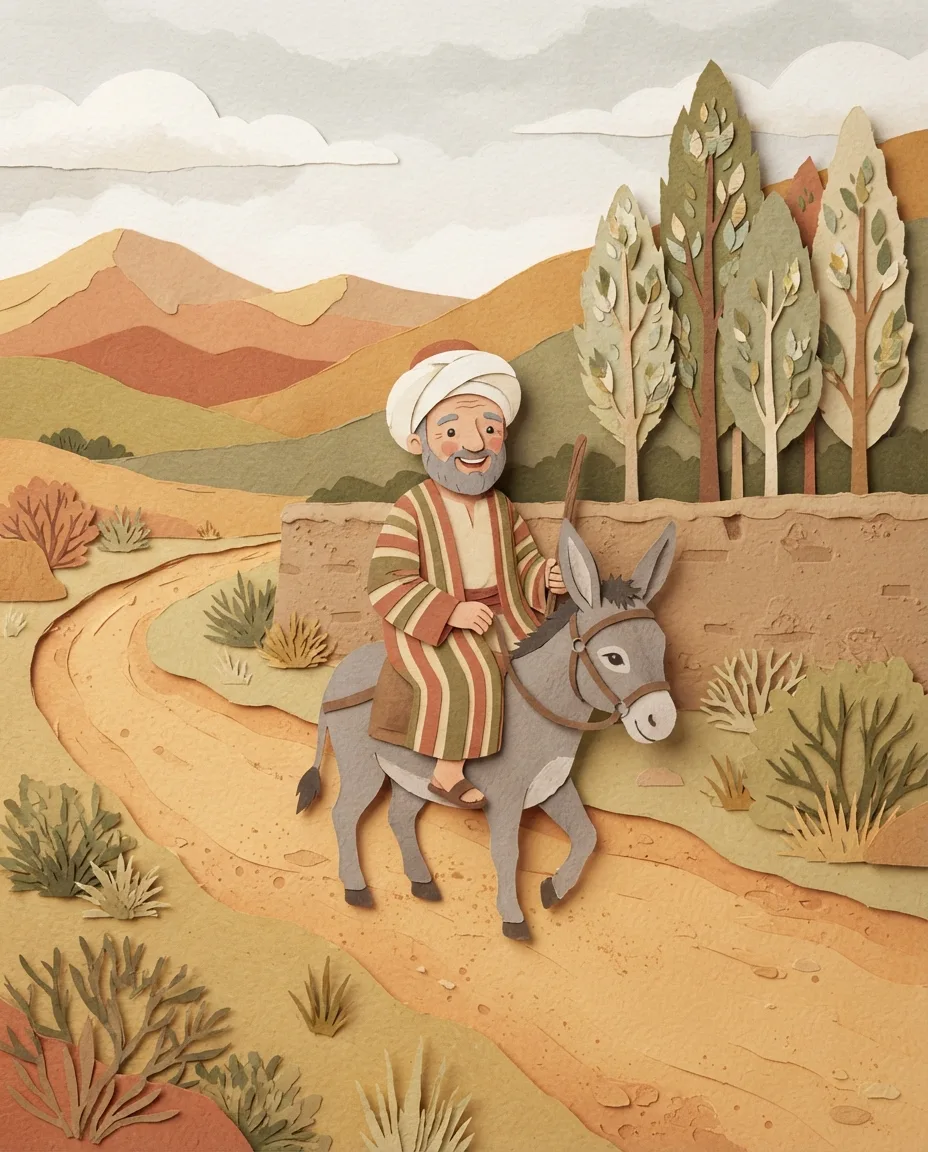
1Who he is
Nasreddin Hodja is the hero of funny stories. He is called “Hodja” in Turkey and “Ependi” among the Uyghurs. Sometimes he is witty or wise, sometimes a fool or the butt of the joke, so he looks different in each story. The stories often carry a light humour and a lesson.
It is not clear whether he was a real person, or when and where he was born.
2The word “ependi”
The word “ependi” goes back to Greek and is said to have spread through the Turkish title efendi. Besides being a title of respect (“Mr”), it is added to the name of a learned person to show respect, and it is used for “teacher”. It is also a nickname of this character, so “Ependi’s jokes” means the stories of Nasreddin.
3Where the stories are told
The stories are told across a wide area: Turkey, the Caucasus, the Balkans and Central Asia, among others. The name differs by language: Kozhanasyr in Kazakh, Nasriddin Afandi in Uzbek, Nesiridin Ependi in Uyghur, and Āfántí (阿凡提) in Chinese.
Where he was born is also told differently from place to place. In Turkey, he is said to have a tomb in Akşehir. Among the Uyghurs he is told of as one of their own land, and among the Uzbeks as a man of Bukhara.
4The Chinese puppet films
In China, the Shanghai Animation Film Studio made “The Story of Afanti”. A single film was made in 1979, and 13 episodes followed by 1988: a puppet series of 14 films in all, with Xinjiang music and costumes worked in.
Sources (7)
- [1]ئۇيغۇر تىلىنىڭ ئىزاھلىق لۇغىتى(ug.wikipedia 転載)見出し語「ئەپەندى」 (2026-10-09)
- [2]Wikipedia (en)「Nasreddin」 (2026-11-25)
- [3]Wikipedia (en)「The Story of Afanti」 (2026-11-25)
- [4]Wikipedia(日本語)「ナスレッディン・ホジャ」 (2026-11-25)
- [5]Fedai, "Mulla or Hodja Nasreddin as seen by Cypriot Turks and Greeks", Folklore 16 (2001)(en Wikipedia 経由。本文は未読) (2026-11-25)
- [6]maigoo「阿凡提的故事」(二次の百科サイト) (2026-11-25)
- [7]TheTVDB「The Story of Afanti」(データベース) (2026-11-25)