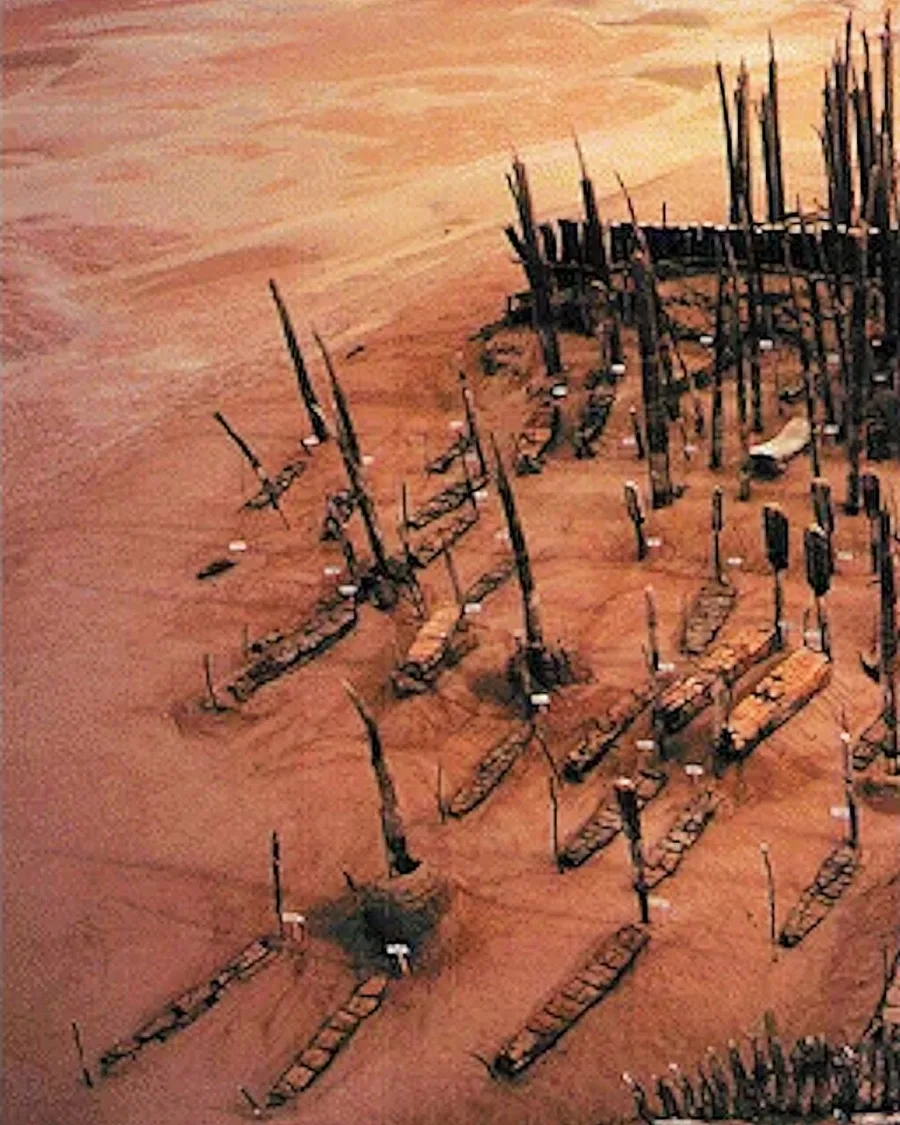
1Graves in a dry desert
The Tarim Basin is a large desert basin in Xinjiang. Over about a hundred years, hundreds of bodies that mummified naturally have been found in cemeteries around the basin.
The extremely dry climate is said to have kept the bodies and cloth from rotting. That is why things that normally return to the soil, such as clothes and hats, survived.
2Xiaohe: coffins like overturned boats
At the Xiaohe cemetery in the Lop Nur region, the Swedish archaeologist Folke Bergman excavated 12 graves in 1934. The site was then lost, found again in 2000, and excavated systematically from 2002 to 2005.
Most of the coffins at Xiaohe are shaped like an overturned boat and were covered with cowhide. One of the women mummies is dated to around 1800 BCE and wore a round white felt cap.
3The man from Cherchen
In 1985, a well-preserved male mummy was found at the Zaghunluq cemetery near Cherchen, on the south-eastern edge of the Tarim Basin. The grave is dated to around 1000 BCE. He wore dark purple woollen clothes and white deerskin boots.
Spiral and sun-like patterns had been painted on his face in ochre pigment.
4A long span of time
The oldest examples go back about 4,000 years (around 2000 BCE). The cemeteries where mummies have been found cover a span of more than 2,000 years.
Researchers disagree about where these people came from.
مەنبەلەر (8)
- [1]ئۇيغۇر تىلىنىڭ ئىزاھلىق لۇغىتى(ug.wikipedia 転載)見出し語「مۇمىيا」 (2026-10-09)
- [2]Wikipedia (en)「Tarim mummies」 (2026-11-25)
- [3]Wikipedia (en)「Xiaohe Cemetery」 (2026-11-25)
- [4]Wikipedia (en)「Cherchen Man」 (2026-11-25)
- [5]Wikipedia(日本語)「タリム盆地のミイラ」 (2026-11-25)
- [6]Zhang et al., "The genomic origins of the Bronze Age Tarim Basin mummies", Nature 2021 (2026-11-25)
- [7]Kamberi, "The Three Thousand Year Old Chärchän Man Preserved at Zaghunluq", Sino-Platonic Papers 44 (1994) (2026-11-25)
- [8]画像: Li et al. 2015, BMC Genetics(CC BY 4.0)「Xiaohe cemetery (fourth layer)」(Wikimedia Commons) (2026-11-25)
