1A tool, and a talisman
A knife is پىچاق in Uyghur. By the roadside, long-bearded farmers are reported to draw their blades from the sheath to slice open juicy melons and sell them.
People have long believed that a knife kept by the bed keeps bad dreams away. A custom is also told that on a baby’s seventh day, the parents briefly slip a blade under the sleeping infant’s head so that the child will live a long and healthy life.
2Yengisar, the town of knives
Yengisar, on the edge of the Taklamakan Desert, is known as a centre of knife making.
3Made by hand
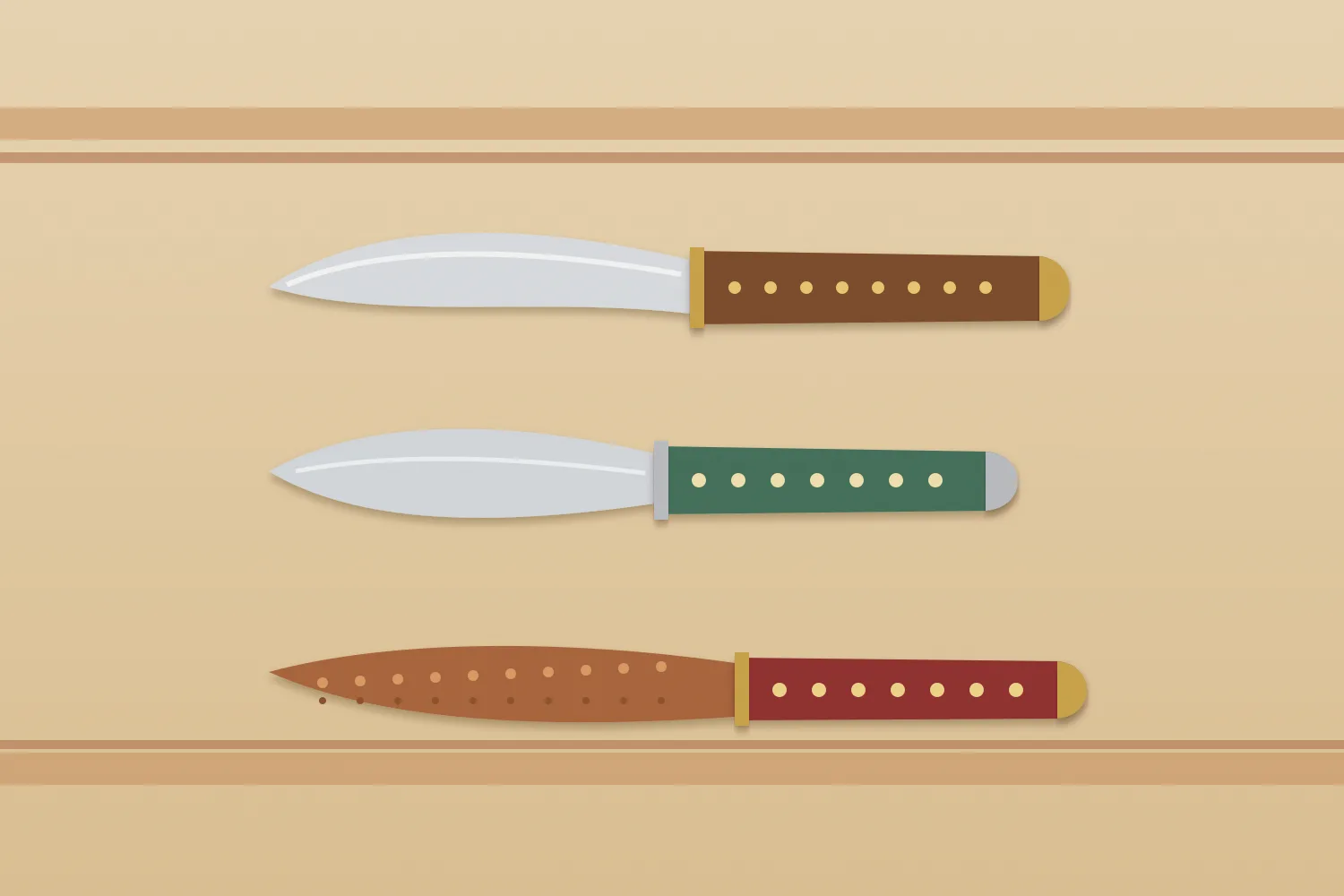
The blade is forged by hand from good steel. The handle is made of copper or bone and inlaid with patterns in silver, copper, jade and gemstones. The sheath is made of cattle or sheep hide pressed in a mould.
A knife is usually 11 to 12 centimetres long, though some are over half a metre and some very short. Blade shapes include the crescent, the fish belly, the phoenix tail, the eagle, a red-billed bird and the head of a lark.
The craftsman’s name and hometown are often inscribed on the blade in the script used for Uyghur, and sometimes in Chinese characters as well.
4A national intangible heritage
In 2008 the “traditional knife-making craft of the Uyghur people” was listed as national-level intangible cultural heritage in China. The craft is passed on mainly in Yengisar County in the Kashgar area and in Xayar (Shaya) County in the Aksu area.
مەنبەلەر (5)
- [1]Kenjisoft 辞書「پىچاق」(dictionary/i4O8GQhs4wsJ1vm4QM7U) (2026-11-25)
- [2]ئۇيغۇر تىلىنىڭ ئىزاھلىق لۇغىتى(ug.wikipedia 転載)見出し語「پىچاق」 (2026-10-09)
- [3]中国非物質文化遺産網「维吾尔族传统小刀制作技艺」(国家級代表的項目 Ⅷ-122、2008年第二批) (2026-11-25)
- [4]Los Angeles Times の記事(Yengisar 発、2014-09-17) (2026-11-25)
- [5]Wikipedia (en)「Yengisar County」(町の名と綴り) (2026-11-25)